Luxor through the years
Where it all began
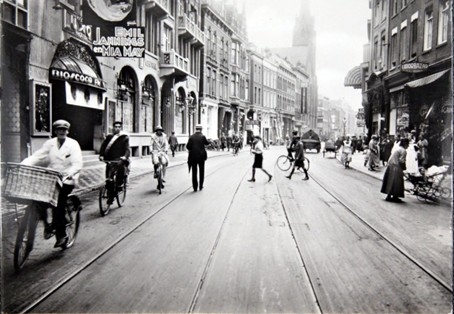
In 1917, two entrepreneurs had the Luxor Theater built on Kruiskade in Rotterdam: a movie theater that was immediately, by far, the largest in the Netherlands. For over a century, the Luxor has been an important part of Rotterdam’s nightlife and continues to evolve.
1917
The Luxor Theater opens its doors at Kruiskade 30, becoming the seventeenth movie theater in Rotterdam at that time. The theater has 1,180 seats and a luxurious interior: thick carpeting, very heavy armchairs, and brass ashtrays in the backrests.

1919
The first full annual report shows that the Luxor movie theater held two evening screenings every day, as well as matinees on Sundays and holidays. In 1919, nearly 400,000 Rotterdam residents bought tickets to see a good feature film and a supporting film.

1928
On May 13, the last movie will be shown at Luxor before the theater—which is only ten years old—undergoes a major renovation. Several adjacent buildings have been purchased, and architect Jozea van Wijngaarden has been commissioned to design a completely new and modern theater within six months.

1933
The relationship with UFA, the German owner and shareholder, began to sour when Hitler came to power in 1933. Although director Herman Bollongino kept Nazi propaganda off the screen as much as possible, many moviegoers refused to go to the theater. Near the Luxor, leaflets were handed out, and activists disrupted screenings by blowing whistles and throwing smoke bombs.

1940
June 1940, one month after the bombing of Rotterdam. The Luxor, along with Hotel Central, was one of the very few buildings in downtown Rotterdam to survive the destruction. Twelve movie theaters in the city center were reduced to ashes and rubble. Besides the Luxor, only the Arena movie theater on West-Kruiskade remained standing.

1947
After the war, Luxor was leased to the Rotterdam Art Foundation. To make up for the loss of the destroyed Rotterdamsche Schouwburg, Luxor temporarily hosted theater performances in addition to movie screenings. The demand for entertainment was enormous. The Schleswig revues featuring Snip and Snap (Willy Walden and Piet Muijselaar) were major crowd-drawers at the time.

1952
Technically speaking, it was all still a bit of a makeshift arrangement. Partly because the Luxor continued to operate successfully (half as a movie theater, half as a popular theater), the city council decided in June 1949 to allocate two metric tons for a thorough renovation. The Luxor was to become a full-fledged entertainment theater. In 1952, the organ (visible on both sides of the stage) underwent a major overhaul, during which its nearly 1,600 pipes were refurbished.

1956
Willy Hofman, director of Luxor since 1952, brings the first major foreign theater production to the Netherlands: the musical *Porgy and Bess*. For the enormous sum of 50,000 guilders, the production runs for ten nights at Luxor. The orchestra pit and the stage had to be remodeled for the production, and the musical proved to be a resounding success.

1960
Willy Hofman, now not only a director but also a theater producer, proves that the Dutch can produce musicals as well. The London hit My Fair Lady, Wim Sonneveld, premieres at the Luxor on October 1, 1960. Seth Gaaikema, then a fourth-year Dutch language student, handled the translation. The production became an unprecedented success: five months of sold-out shows, 836 performances, and nearly a million attendees.

1962
Since the Luxor is one of the largest theaters in the Netherlands, major international stars regularly come to Rotterdam. On December 13, 1962, Edith Piaf performed at the Luxor. De Telegraaf wrote: “On Thursday evening, an entire Luxor Theater full of down-to-earth Rotterdammers was transformed into a crowd possessed by an un-Dutch enthusiasm, all thanks to one petite woman: Edith Piaf.”

1966
Luxor is the place where the “Big Three” (Toon Hermans, Wim Sonneveld, and Wim Kan) first appeared on stage. Just like Wim Kan’s ABC Cabaret and Wim Sonneveld’s Ensemble Sonneveld, Toon also started out performing with a troupe: Floris Meslier’s Theater Plezier. In 1966, he performed for weeks to sold-out audiences in his fifth one-man show.

1972
The Oude Luxor was becoming increasingly dilapidated. In 1972, a very thorough renovation began, during which architect Wirtz left practically only the exterior walls standing. Fifteen months and 5.4 million guilders later, the old venue on Kruiskade was barely recognizable. The building no longer has a balcony, and from that point on, the auditorium had 909 seats and its distinctive light ring.

1987
For the third time, Luxor is organizing a Cabaret Marathon as a festive finale to the season. Twenty-four hours of cabaret, nonstop. It’s a massive undertaking: 47 acts perform, including Freek de Jonge, Brigitte Kaandorp, Mini & Maxi, Herman Finkers, and Waardenberg and De Jong. A dispute over noise pollution with the management of the adjacent Hotel Central leads to summary proceedings, but the threat of Luxor’s closure is averted.

1998
After years of research into the possibility of a new theater, the decision has finally been made. A new, large theater will be built on the Kop van Zuid, at the foot of the Erasmus Bridge. At that time, the Wilhelminapier was still a dilapidated port area with, apart from Hotel New York, many vacant buildings. Alderman Hans Kombrink and Freek de Jonge jointly drove the first pile for the new theater, which was designed by architect Peter Wilson.

2008
The musical*Les Misérables* will be performing exclusively at the Nieuwe Luxor for nearly nine months. This production, which is the longest-running musical of all time worldwide, once again features a top-notch cast (including René van Kooten, Jamai Loman, Freek Bartels, and Carlo Boszhard) and an enormous set. The show is a huge success and is seen by 320,000 visitors.

2014
Whereas in 2006 the decision was made to renovate the Oude Luxor, in 2013 work will finally begin on yet another large-scale renovation. Antwerp architect Aude de Broissia is giving the theater more spacious lobbies, a restaurant, and a “modern facade” inspired by the one from 1928.

2016
The show*De Oase Bar*, starring Gerard Cox and Joke Bruijs and based on Jaap Valkhoff’s famous bar, draws 25,000 visitors to the Oude Luxor. This new show proves to be a huge hit: an evening of pure variety entertainment. Thanks to the guest artists (Martin van Waardenberg, Lee Towers, Jacques Herb, Richard Groenendijk), the evening is so varied that a large portion of the audience even attends the show multiple times.

2017
The 2012 hit film *The Marathon* serves as the basis for a new Rotterdam production that has been fantastically received by the press and the public. The musical’s run is extended several times and attracts 55,000 visitors in Rotterdam. The purple-and-yellow running shirts sold at the show are seen in large numbers at running events such as the NN Rotterdam Marathon.

2017
On December 22, 2017, Luxor celebrated its 100th anniversary. We celebrated this anniversary with the temporary exhibition “Luxor 100 Years” and two unique performances:“Defileeuw” by Paul de Leeuw (at “De oude dame”) and the anniversary performance by Waardenberg and De Jong & the ladies of Toren C (the Nieuwe Luxor). In addition, an artists’ parade was held in the city center: festive flags flanked dozens of artists who have played significant roles over the past 100 years.

2020
Like every theater, Luxor has also been closed for a considerable amount of time due to the COVID-19 virus. A total of 927 performances and events were canceled or rescheduled. It was important to Luxor to let artists, visitors, and staff enjoy the theater again, which is why alternative performances were organized under the name Club Luxor. With tables and chairs on stage and snacks and drinks served during the performance, visitors feel as if they’re at a club concert or in a comedy club.

2022
Café Dox is opening. The café is located in the Nieuwe Luxor, where theater, the city, and the public come together. It’s a place to have lunch, work, and socialize during the day, and to enjoy dinner in the evening before a performance. But Café Dox also has its own stage with free events open to all Rotterdam residents. With this programming, we’re putting local artists in the spotlight and providing a springboard for emerging theater makers.

2024
The Container Staircase is the latest hotspot at the Nieuwe Luxor. This is the place where theater artists can test out their work or exhibit their creations, and where visitors get their first glimpse of these new talents. But that’s not all; the Container Staircase is also literally used as a staircase leading up to the rooftop terrace of the Nieuwe Luxor. From here, you’ll enjoy a fantastic view of the transformation of the revitalized Rijnhaven.
